The Bank of Canada's Governing Council kept its policy rate at 2.25% on July 15, and the summary of its deliberations, published two weeks later, offers an unusually candid look at how six policymakers weighed a rebounding economy against a volatile world.
The starting point was sobering. Members noted that GDP had essentially not grown between the first quarter of 2025 and the first quarter of 2026, with U.S. tariffs and trade uncertainty holding the economy in excess supply. But the more recent indicators told a different story: exports had resumed growing, oil and gas investment was picking up, home resales had turned positive, and the May and June jobs reports showed hiring back on. The Council expected second-quarter growth of about 2.5%, with the economy strengthening from 0.7% for 2026 as a whole to 1.8% in each of the next two years.
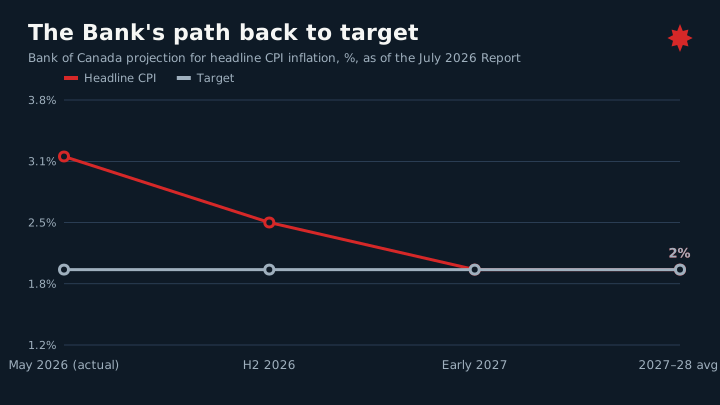
On inflation, gasoline dominated. The Middle East war had driven benchmark oil to roughly US$120 a barrel in April, lifting headline CPI to 3.2% in May, while inflation excluding gasoline was 2.2% and core measures held near 2%. With oil back near US$75 by June, staff projected inflation easing to about 2.5% in the second half of 2026 and reaching target in early 2027 — a forecast members acknowledged was clouded when hostilities flared again during their own meetings.
Members agreed they would not let higher oil prices lead to persistent inflation.
The Council settled on looking through the direct effect of energy prices, noting limited spillover so far into other goods and services, while warning that the longer oil stays high, the greater the risk it broadens. Some members worried about a drift in medium-term inflation expectations; all agreed longer-term expectations remained anchored.
Where the committee split was on durability. Everyone was confident about the second-quarter bounce; views differed on whether it would be sustained if businesses stop adapting to tariffs, if exports and investment again underdeliver, if the condo overhang in Toronto and Vancouver stalls housing, or if soft hiring finally wears down consumers. The conclusion was that the policy trade-off had eased — growth resuming, inflation easing — but that uncertainty remained high enough to warrant sitting still and watching the data.