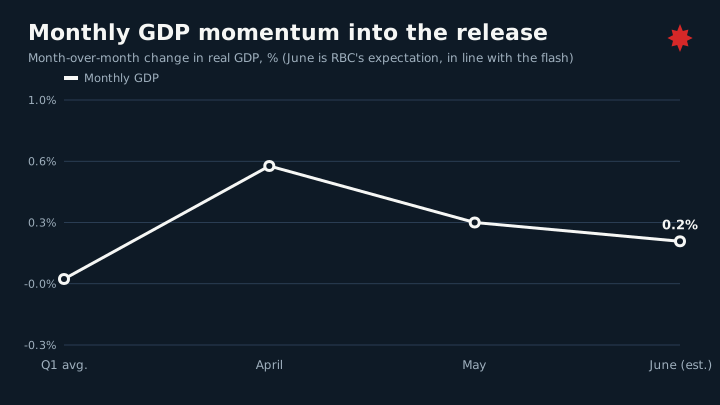
Next week's GDP reports for June and for the second quarter are expected to confirm a strong rebound after growth stalled over the winter, RBC's economists wrote in their Forward Guidance note for the week of August 24. The bank looks for a 0.2% gain in June, matching Statistics Canada's flash estimate, on top of nearly a full percentage point of growth across April and May. The monthly figures are prone to revision, but they track above 3% annualized for the quarter.
Part of that strength is payback for temporary weakness earlier in the year, particularly in the auto sector, where production disruptions over the winter reversed in the spring and lifted net exports. But the note argues the improvement runs deeper than trade. RBC's own cardholder data show consumer spending firmed despite higher fuel costs, a jump in equipment imports points to stronger business investment, and residential investment appears to have rebounded alongside improving resales and housing starts.
Early third-quarter signals — consumer spending and a pickup in hours worked in July — have stayed constructive. RBC expects growth to moderate from the second quarter's pace but remain positive through the rest of 2026, consistent with a gradual cyclical recovery and further gains in per-capita output even as the population declines.
Aug. 24 update: the preliminary trade deal faltered at the last minute, and 50% tariffs have been imposed on about 5% of U.S. imports from Canada.
The note was written on the day of the tariff deadline, when early reports still suggested existing duties on autos, steel and aluminum might even be lowered. Three days later the authors added a postscript: the deal had collapsed and the 50% tariffs were in force. RBC does not expect the measures to significantly alter Canada's near-term growth backdrop, given that most trade remains duty-free under CUSMA, but warns of significant disruption to the targeted industries.
The bank's forecast rests on a familiar caveat. Trade uncertainty and product-specific tariffs remain a headwind for investment, the auto and net-trade boost will not repeat, and elevated uncertainty is the dominant risk to a recovery that, for now, is broadening.